
David Perfect Remembered
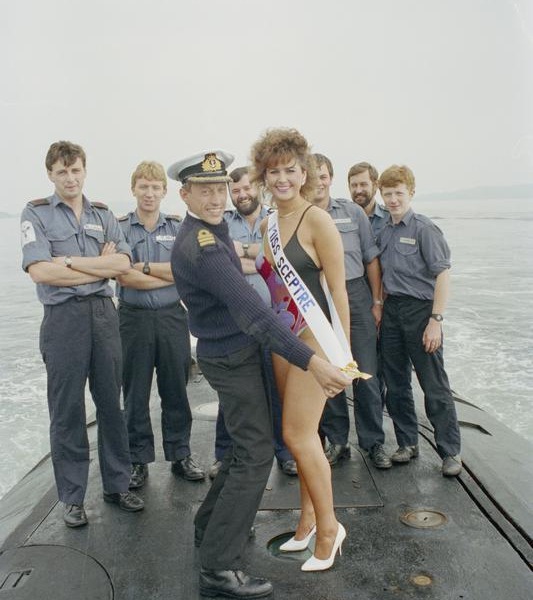
Copyright: © IWM
From Charles Hume
I served with David in Conqueror in mid 1978, when I was the training/augment engineer, and believe it or not I am pretty sure he was the supply officer (in those days a seaman officer fulfilled that role though it was shortly to change!).
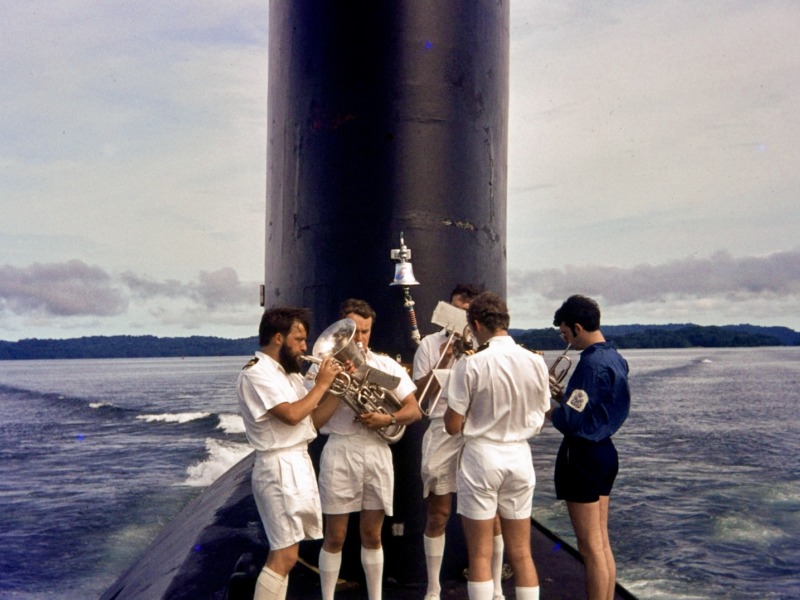
We were deployed to the west coast of the States with a large group of surface ships for more than six months, and had a brilliant time (never to be repeated in my career). We were young and the considerable amount of time spent accommodated in hotels, with a surfeit of 20 dollar bills, enabled many high jinks, of which David, as you would expect, took a full part. Memories are a little vague, but one that I thought you might find useful was David’s interest in brass band music. He had borrowed a set of brass band instruments from the RM Band school, and formed a small band and we used to practice in the AMS! Roger Trussel, who was our Captain, loved it and insisted we played on the casing for the many harbour entries in the programme, which seemed to impress the americans. Other band members were David Flinders (Euphonium), MEA Thomspson, Trumpet, Me (2nd Trumpet, John Fuller (Trombone). I can’t actually remember what David played but I think he could turn his hand to fill in almost anywhere. Our party piece was The Floral Dance which had recently been taken to Top of the Pops by The Brighouse and Rastrick Colliery band.
I have attached the only photograph I have of the band (from a slide). I think that is probably David’s back?
- Previous Post Submarine Centre – Helensburgh
- Next Post SM125 – Military v Cancer
3 comments on “David Perfect Remembered”
I remember the band playing the Monty Python theme on transit through the Panama Canal…
I attended David’s funeral service on 1st October and as a friend of 58 years standing I was pleased to be asked to present a tribute at the service. Our friendship began at BRNC in 1968. My eulogy contains some elements from the many messages I received from the submarine community. Not mentioned is the fact that David sadly slowly lost his eyesight over about 20 years or so, and was registered as blind a few years ago; his wish is for donations in his memory to be made to the charity Blind Veterans UK. For anyone who would like to read it, my eulogy follows.
EULOGY
On the 15th of September 1968, the Flying Fickle Finger of Fate, a cultural reference from the time that might be lost on some of you, dropped David and me into each other’s path as we stepped off the train at Kingswear station, and waited to take the trip across the River Dart to the Britannia Royal Naval College standing high above the town of Dartmouth. A scene, that when I described it recently to our younger daughter Polly, she likened to Harry Potter arriving at Hogwarts.
On arrival at the college, the naval equivalent of the Sorting Hat placed David and me in Drake division where, after an initial three months in a large dormitory, the two of us, whether by chance or choice – I can’t remember – found ourselves sharing a small two-berth cabin, the navy’s aim being to train us to live tidily in tight confines with another human being – here our friendship was forged – although tidiness didn’t come naturally to either of us.
I didn’t know back then, but for David this was his second time arriving at Dartmouth. A year older than me, he had gone into a Royal Naval recruiting office in his beloved Sunderland with a desire to be the captain of a ship; he would go on to be awarded a scholarship to Dartmouth, but somewhere along the way, probably given his prowess in physics and mathematics – subjects he would teach professionally in later life – he was persuaded to change his aspirations of commanding a ship and instead be trained to become an engineer officer. Perhaps it was the opportunity to be in a co-educational university in London with the rank and pay of a Midshipman that deflected him from his original plan, but at some point in his first year he realised he’d made a huge mistake and he asked to change course and train to be the seaman officer he had always wanted to be; this was not before he had had the opportunity – and good fortune – to meet Ursula.
This change of course in David’s career required him to leave the Navy for 24 hours at the end of his university year and join Dartmouth once again but this time as an Officer Cadet, the usual starting rank. So David was – as the navy would refer to him – an “old hand” when I met him, and while the cadet intake for our year was confined to the college for the first three months to get us used to being away from the joys of life ashore, David was using his past knowledge to slip out unnoticed via the married quarters area for an evening in a local pub where he had his own seat at the bar and was a member of the darts team; such clandestine tactics surely earmarked him to be a future submariner.
For our Midshipmen year, David and I, along with ten other midshipmen, joined the Commando Carrier HMS Bulwark. After six happy months steaming around the Mediterranean and down to South Africa, we parted company while Bulwark was on passage to the far east; David went to Bahrain and a mine-hunter squadron, while I stayed onboard heading to Singapore and the 7th Submarine Squadron; we didn’t know that this would mark the last time we would ever be at sea together.
At the end of the year, David sat his Midshipman’s Board in Bahrain; the board went very well as expected – until his Midshipman’s Journal was reviewed. The board noted a rather critical report that David had made in his journal about an expletive laden re-commissioning speech the Captain of Bulwark had delivered; David thought it entirely improper for a senior officer to address his ship’s company in this way and stated as much. The board decided that David’s criticism of a senior officer was inappropriate and for this reason alone he was told that he had failed his board. Fortunately David had allies and the board’s decision was overturned, allowing his career to continue without another unexpected break – but not before, in a display of his headstrong side, David had hurled his Midshipman’s journal off the stern of his ship into the waters of the gulf.
After our fourth year of training the time came to choose a specialisation. David and I both volunteered for the submarine service. We arrived together at HMS Dolphin in the first year that the navy allowed recruits to choose to go directly into the nuclear powered arm of the flotilla, rather than taking the traditional path of training in the conventional diesel-electric boats. I chose the traditional route having thoroughly enjoyed my diesel boat time in Singapore, but David had no such affiliation. He saw nuclear boats as the future and he wanted to be at the sharp end of the flotilla from the outset. Over the next six years David would serve in three nuclear boats while learning his trade: HMS Courageous, Repulse and Conqueror.
In 1979 he joined HMS Opportune as the First Lieutenant and had his first taste of a diesel submarine. Tony Taylor, Opportune’s Captain, has told me about an occasion during a period of dockyard work-to-rule in Devonport when cranes weren’t available, but the boat had defective engine parts that needed to be offloaded. Taking matters into their own hands risked offending the unions and could have been interpreted as strike breaking. David, however, as First Lieutenant, decided that it was in the best interest of all concerned to carry on regardless. This was despite Tony relaying an order to David from Captain SM to desist when he heard that the transfer had started. Undeterred David continued and the equipment was offloaded with ropes and pulleys, the final item being swung ashore just as Captain SM drove by on a detour on his way home. David’s actions earned Tony Taylor, in his own words, “the biggest wire brushing I had hitherto ever received” but he thought that Captain SM, Dick Husk, secretly admired David for getting the job done.
In 1980 David completed the Perisher submarine command course and fulfilled his childhood goal with three command postings that followed. Firstly as the second-in-command and executive officer of HMS Trafalgar in refit and then in commission; then in 1986 as the commanding officer of HMS Osiris – his second dip into the murky world of diesel boats which included a six-month deployment to the Falkland Islands – before he returned to the freshly laundered nuclear boats in 1987 on promotion to Commander as the captain of HMS Sceptre operating at the front line in the Cold War. When I asked the submarine community for memories of David I received many messages all universal in voicing their praise: extremely able, compassionate and enthusiastic, a very quick brain, a natural and most professional submariner, a man of great integrity, a man with prestigious professional knowledge and competence, he was a character the ships’ company would have followed anywhere, an extraordinary Skipper, the best I had in over 20 years as a submariner, and – adored by his ship’s company.
I’ve heard too about a very successful display of attacking by HMS Sceptre under David’s command, when they were tasked secretly to participate in an exercise stateside tasked against three American nuclear boats; Sceptre duly hunted down and successfully attacked all three boats who thought the exercise had been infiltrated by Soviets. When alongside at the submarine base in Norfolk, Virginia, post exercise, the US Admiral called for David to see him – David was a bit worried – but he met the Admiral, with the captains of the three submarines David had attacked present, and the Admiral offered him a job to teach them how to attack – such was David’s prowess.
In 1989 David left HMS Sceptre and returned to the Perisher course as one of the two Teachers, a position that only a select number of successful perisher students have achieved. So David went on to train, mentor and bestow qualification on many embryo submarine commanding officers. I have heard from some of his former students who echo the same thoughts about how privileged they feel to have had him as their Teacher, how inspirational and hugely respected he was, and how brilliant he was at passing on his deep knowledge of all things submarining.
Away from the cut and thrust of submarine operations, David was great company and gregarious by nature. He would happily strike up a conversation with anyone and on a wide range of subjects – often with earnest authority, although sometimes his certainty could be misplaced! Over the years I have sometimes had occasion to challenge a questionable assertion he had made; when he agreed with such a challenge he would do so with a howl of laughter and utterances of “yes of course, of course, quite right, quite right” followed by another howl of laughter.
And then there’s David’s musical talents about which I’ve also received many messages – for a start he was the only person I knew who could play the spoons. Will Worsley has told me about an occasion during a visit to Fort Lauderdale, at the end of their Falkland’s deployment in Osiris, when David and his officers were invited by a wealthy American couple to their yacht club and then back to their house for after lunch drinks. Will said “Somehow or other David mentioned he played the spoons. Curious, they had him explain more and then invited him to give a demonstration; they brought out gold dessert spoons whereupon David gave a dazzling display of percussion with their priceless spoons.”
He was also talented on the piano and with wind instruments – particularly the trumpet and tuba. I’ve heard from his band mates about a small brass band David formed while in HMS Conqueror, with instruments he borrowed from the Royal Marine Band School; they practised below the waves and played on the casing, for many harbour entries, and also while transiting the Panama Canal in 1978. David was also the only person I knew who could get a tune from one end of a tubular metal bedstead. Johnny Milnes, who relieved David as the captain of Sceptre, also has an abiding memory of David playing “God Save the Queen” on the tubular coat stands down in the Wardroom loos at the submarine base in Faslane.
And David was also a great fan of “Uckers” – the naval version of the family game Ludo, but on steroids. While in command of HMS Osiris he commissioned a unique six-sided board which gave the opportunity for even wilder rules than usual; Will Worsley recalls David’s joy at seeing a new rule play through on this new board, he said: “I recall vividly David laughing that whole-hearted laugh of his, while clapping his hands in glee and simultaneously throwing his head back that expressed his joy on those occasions. Those visions of his “Joie de Vivre” seem so fresh even 40 years later.”
There were so many facets to David but, in short, he was a hugely talented and respected submarine captain, a talented musician and academic, great company and a great friend; being with David was always such good fun.
And behind all the derring-do of David’s submarine career, and behind his scholarly achievements in his second career teaching maths and physics – where I don’t doubt his pupils also refer to him as a bit of a legend – David was a family man at heart and he was so very proud of his children and grandchildren.
Nine years ago when a friend in our village died, I wrote a song and dedicated it to his memory. The song is simply called “My Friend”. The lyrics describe two friends who meet regularly to talk about their lives, and how life is really just made up of memories. Then one of them dies and his friend reflects with these words:
I’ll remember all the joy there’s been
The fun and the laughs along the way
Remember how it used to be
And as each day meets its end
You’ll still be with me my friend.
David’s eulogy
1st October 2026
An excellent eulogy. I served with David Perfect in COURAGEOUS many long years ago. He became part of the ship’s band, playing at Sunday Service at sea. He was brilliant playing the spoons, guitar, trumpet and anything that made aa pleasing sound. A good man and fine shipmate.
Gavin